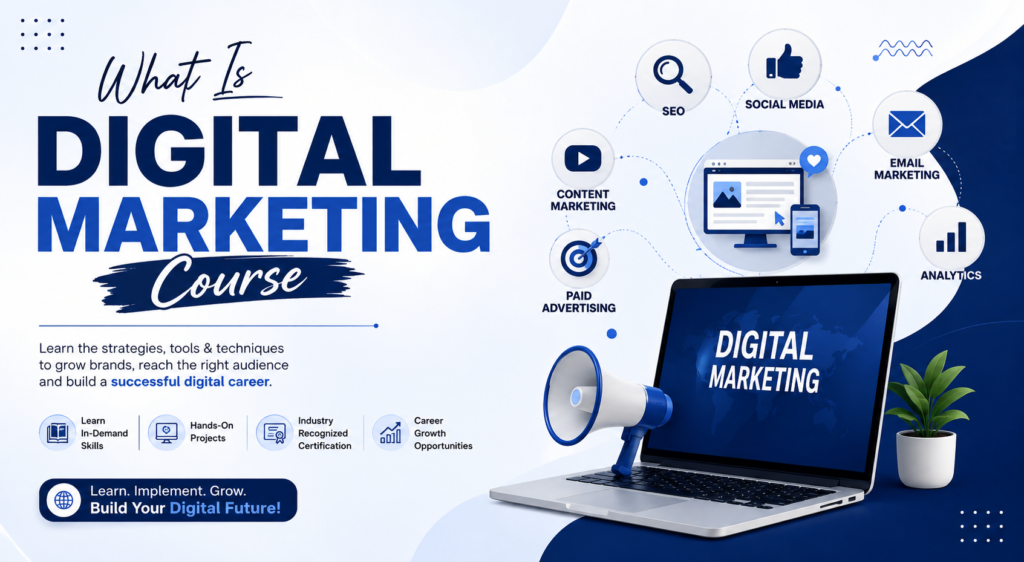
What is a Digital Marketing Course? A digital marketing course teaches you how businesses promote products and services online using SEO, social media, Google Ads, content marketing, email marketing, and analytics. It helps beginners build practical skills for digital marketing careers. WHAT IS A DIGITAL MARKETING COURSE? | COMPLETE INFORMATIVE GUIDE Introduction Hello everyone, welcome back to the vlog! Today, we are going to talk about a very common question that many students, freshers, business owners, and working professionals have: What is a Digital Marketing Course? You may have heard people talking about digital marketing, SEO, Google Ads, social media marketing, content marketing, and online advertising. But what exactly do you learn in a digital marketing course? Who should take one? What skills can you develop? And what career opportunities can you explore after completing the course? In this informative vlog, we are going to answer all of these questions in simple language. So, let’s get started. What Is Digital Marketing? Before understanding a digital marketing course, we first need to understand digital marketing itself. Digital marketing is the process of promoting a business, product, service, or brand through digital channels. Today, people spend a large amount of time online. They search for products on search engines, watch videos, use social media, read reviews, visit websites, and communicate through digital platforms. Businesses use these platforms to reach potential customers. For example, if you search for “best digital marketing institute near me” on Google and see an advertisement from an institute, that is digital marketing. If you see a brand promoting its product on Instagram, that is also digital marketing. If you watch a YouTube video created by a company to educate customers about its product, that is another example. Digital marketing includes many different areas, and a digital marketing course is designed to teach you how these areas work. So, What Is a Digital Marketing Course? A digital marketing course is a structured learning program that teaches students how to plan, create, manage, and measure online marketing campaigns. The course usually covers multiple areas of digital marketing instead of focusing on only one skill. Depending on the institute or program, the course may include topics such as: Search Engine Optimization, or SEO Google Ads and paid advertising Social media marketing Content marketing Email marketing Website and landing page basics Google Analytics and reporting Lead generation Performance marketing Affiliate marketing Online reputation management Marketing automation AI tools for digital marketing The exact syllabus can be different from one course to another. Some courses are designed for beginners, while advanced programs may focus more on campaign management, analytics, strategy, and performance marketing. Why Is Digital Marketing Important? Digital marketing has become important because customer behavior has changed. Think about how people make purchasing decisions today. Before buying a product, many people search online. They compare prices. They read reviews. They watch videos. They visit websites. They check social media. They may even ask questions on online communities. Because customers are spending more time online, businesses need to be visible where their audiences are. Digital marketing helps businesses reach potential customers through these online channels. For this reason, there is growing interest in digital marketing as a professional skill. A digital marketing course helps learners understand how these channels work and how businesses can use them strategically. What Do You Learn in a Digital Marketing Course? Now let’s look at some of the major subjects that are commonly taught. 1. Search Engine Optimization SEO stands for Search Engine Optimization. It is the process of improving a website and its content to increase its visibility in search engine results. For example, imagine you own a digital marketing institute. You may want your website to appear when someone searches for “digital marketing course.” An SEO professional works on different aspects of the website to improve its search visibility. In a digital marketing course, students may learn about: Keyword research On-page SEO Technical SEO Off-page SEO Content optimization Internal linking Competitor analysis Search intent SEO reporting SEO is an important skill because businesses want to attract people who are actively searching for their products or services. 2. Google Ads and Paid Advertising Another important part of digital marketing is paid advertising. Google Ads allows businesses to advertise on Google’s platforms and reach people based on searches, audiences, interests, and other signals. A digital marketing course may teach students how to create and manage different types of campaigns. Students can learn about: Keyword research Campaign structure Ad groups Ad copy Bidding Audience targeting Conversion tracking Landing pages Campaign optimization Performance analysis For example, if someone searches for “best digital marketing course,” a business may want its advertisement to appear for that search. Learning how to create relevant and effective campaigns is an important digital marketing skill. 3. Social Media Marketing Social media marketing focuses on using platforms such as Instagram, Facebook, LinkedIn, YouTube, and other social networks to build awareness, engagement, and business results. A digital marketing course may teach students how to: Create social media strategies Research target audiences Plan content Create social media campaigns Analyze engagement Run paid social media advertisements Measure performance For example, a clothing brand may use Instagram to showcase products and communicate with customers. A B2B company may use LinkedIn to reach business professionals. The strategy depends on the audience and business objective. 4. Content Marketing Content is one of the foundations of digital marketing. Content can include blogs, videos, social media posts, infographics, emails, guides, and more. Content marketing focuses on creating useful and relevant information that attracts and engages a target audience. In a digital marketing course, students may learn how to: Research content topics Create content strategies Write blogs Develop content calendars Create social media content Optimize content for search engines Measure content performance Good content should not simply promote a business. It should provide value to the audience. 5. Email Marketing Email marketing is another important digital marketing channel. Businesses use email to communicate with existing
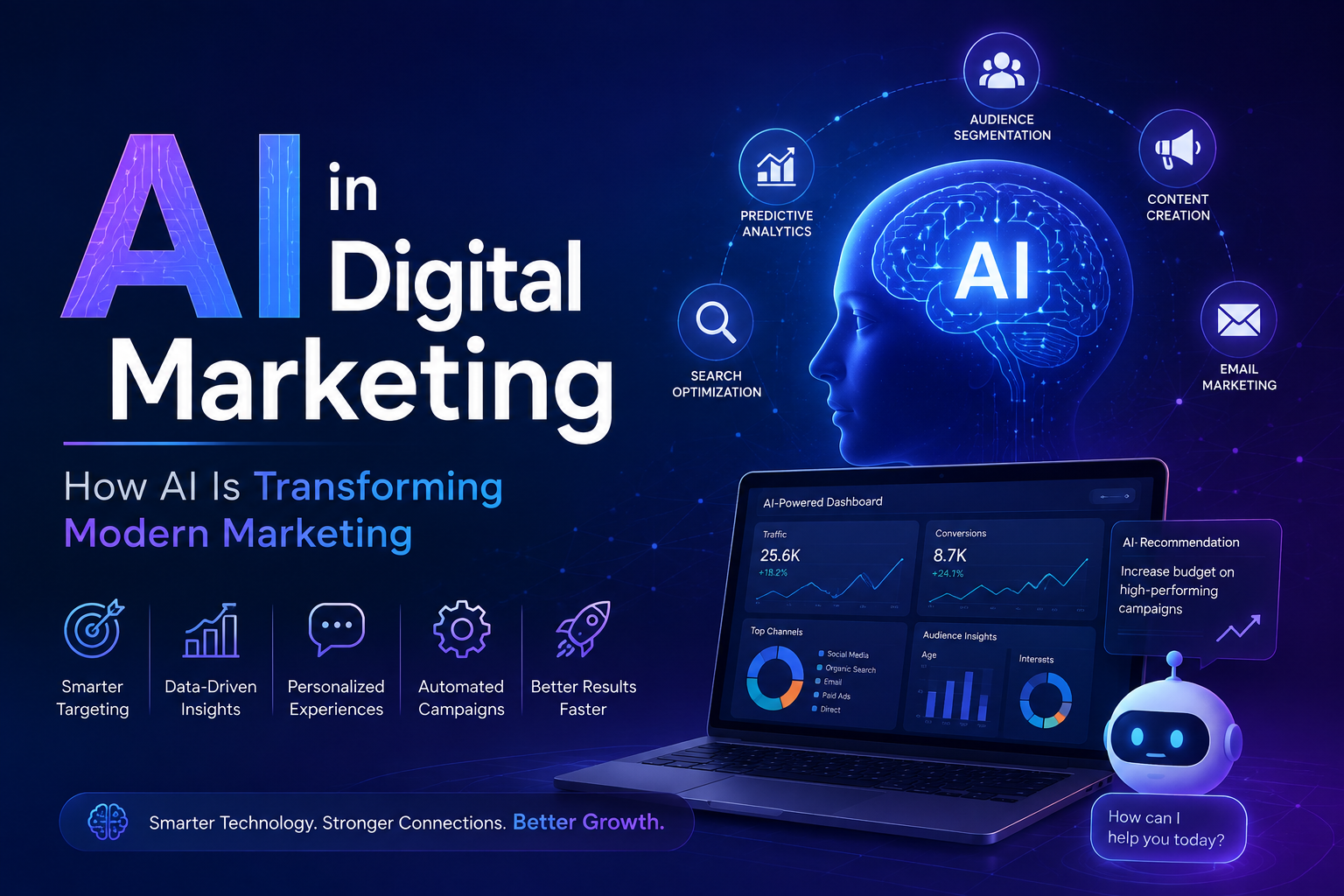
Artificial Intelligence (AI) is changing the way businesses approach digital marketing, making campaigns smarter, faster, and more personalized. In this vlog, we explore how AI is becoming an important part of modern digital marketing and how marketers can use it to improve their strategies. AI can analyze large amounts of customer data, understand user behavior, identify trends, and help businesses make better marketing decisions. From content creation and keyword research to audience targeting and campaign optimization, AI tools can save marketers valuable time and improve efficiency. AI is also transforming search engine optimization by helping marketers identify relevant keywords, understand search intent, and create content that provides better value to users. In social media marketing, AI can help businesses analyze engagement, suggest content ideas, identify the right audience, and determine suitable times to publish posts. In paid advertising, AI can analyze campaign performance and help optimize bids, audiences, and ad placements to improve results. Another major benefit is personalization. AI can help businesses deliver relevant messages, product recommendations, and offers based on customer interests and online behavior. However, AI should not completely replace human creativity and decision-making. Marketers still need strategy, critical thinking, originality, and an understanding of their audience. The most effective approach is to combine AI technology with human expertise. In this vlog, we will look at practical applications of AI in digital marketing, the benefits it offers, the tools marketers can explore, and some challenges they should keep in mind. Whether you are a business owner, student, marketer, or digital marketing professional, understanding AI can help you stay competitive in a rapidly changing industry. AI is not simply a trend; it is becoming a powerful marketing assistant that can help businesses work smarter, understand customers better, and achieve stronger results. As technology continues to evolve, marketers who learn how to use AI responsibly and strategically will be better prepared for the future of digital marketing. AI in Digital Marketing: How AI Is Transforming Modern Marketing IntroductionHello everyone, welcome back to the vlog. Today, we are going to talk about a topic that is changing the digital marketing industry very quickly — Artificial Intelligence, or AI, in digital marketing. You may have already seen AI tools that can write content, generate images, analyze data, create advertisements, answer customer questions, and even help with marketing strategies. But AI in digital marketing is much bigger than simply using a tool to generate content. AI is changing how marketers understand customers, create campaigns, analyze performance, automate repetitive tasks, and make business decisions. In this vlog, we will understand what AI in digital marketing actually means, how marketers are using it, its major benefits, its limitations, and what the future of digital marketing could look like with AI. So, let’s get started. What Is AI in Digital Marketing? First, let’s understand what Artificial Intelligence actually means. Artificial Intelligence is technology that allows computers and software to perform tasks that normally require human intelligence. These tasks can include understanding language, recognizing patterns, analyzing information, making predictions, and generating content. When we combine AI with digital marketing, AI helps marketers use data and technology to make marketing activities more efficient and targeted. For example, a business may have thousands of customers visiting its website every month. Each customer may have different interests, behaviors, and preferences. Analyzing all of this information manually can take a lot of time. AI can process large amounts of data quickly and identify patterns that marketers can use to improve their campaigns. Why Is AI Becoming Important in Digital Marketing? Digital marketing produces a huge amount of information every day. Businesses collect data from websites, social media platforms, search engines, advertising campaigns, emails, and customer interactions. The challenge is not simply collecting this data. The real challenge is understanding it and turning it into useful decisions. This is where AI can help. AI can analyze information, identify patterns, automate repetitive processes, and provide recommendations. For example, instead of manually analyzing thousands of customer interactions, marketers can use AI-powered systems to identify common customer behaviors. This allows marketers to spend more time on strategy and creativity instead of repetitive tasks. AI in Search Engine Optimization Let’s start with one of the most important areas of digital marketing — SEO, or Search Engine Optimization. SEO is the process of improving a website and its content so that it can become more visible in search engine results. Traditionally, SEO professionals spend a lot of time researching keywords, analyzing competitors, understanding search intent, finding content opportunities, and monitoring rankings. AI can assist with many of these activities. For example, AI tools can help marketers generate keyword ideas, organize topics, identify related searches, analyze content, and understand what users may be looking for. Let’s take an example. Suppose someone searches for: “Best digital marketing course for beginners.” A marketer should not only focus on the keyword itself. They should understand the searcher’s intention. Is the person looking for course fees? Are they looking for certification? Do they want placement assistance? Are they looking for online or offline training? AI can help marketers analyze patterns and understand these different possibilities. However, there is one important thing to remember. AI should support SEO professionals, not replace them. Content still needs to be accurate, useful, original, and relevant to the audience. AI in Content Marketing The next area is content marketing. Content is a major part of digital marketing. Businesses create blog posts, social media posts, videos, advertisements, emails, landing pages, and many other types of content. Creating content consistently can be time-consuming. AI can help marketers with brainstorming, research, content outlines, drafts, summaries, and content variations. For example, imagine you want to create a blog about digital marketing. Instead of spending hours trying to decide what sections to include, you can use AI to brainstorm possible topics and create an initial structure. You can then review those ideas, add your own experience, research the information, and create the final content. This is an important distinction. AI can help with
rehferfnuerjfierf